Showing posts with label AV Referendum. Show all posts

Wednesday, 13 April 2011

AV vote becoming increasingly partisan

I fear that this Alternative Vote referendum is becoming more and more about party political preference rather than what it should be, a question of how best to represent the wishes of voters. This isn't a sleight aimed at any party, or indeed any individuals, and both sides of the referendum are engaging in it, it's merely an observation which is really quite disappointing.


This vote shouldn't be about what system will help which party, but yet many, many people who's views I respect and agree with on so many other things are basing their support or opposition to the Alternative Vote based on how it will affect their political party. They argue that what is in the interests of their chosen party is in the interests of the country, and so any change to the system which is bad for their party is bad for the country, and vice versa.

Whilst the belief that the interests of your party are in the interests of the nation seems a rather natural belief, it should have no bearing on this referendum. You cannot drag the electorate along with you based on a malfunctioning voting system, you have to earn and keep their trust. When judging electoral systems you should look at it from a completely impartial point of view, and base your decision on whether or not said system reflects the wishes of the nation. If that harms your party, then tough, you should focus more energy into making sure you do represent them.

Too many people in this country don't have a vote that matters. AV is not a cure-all, but it will end the very worst of FPTP in that it takes away the need for tactical voting. I find it outrageous that in a modern democracy people cannot vote for the candidate they prefer simply for the fear of letting in someone worse. If all that happens is AV is the end of this kind of campaigning then I think it will have been worth doing.

I may dislike Tory policy, but is it right that people are denied the chance to vote for them?

I have already made many cases for AV, but this was simply me expressing my exasperation that party politics kept getting dragged into the debate. This is about making sure that MPs truly represent their constituents, not just the ones that are members of their party.

Tuesday, 22 February 2011

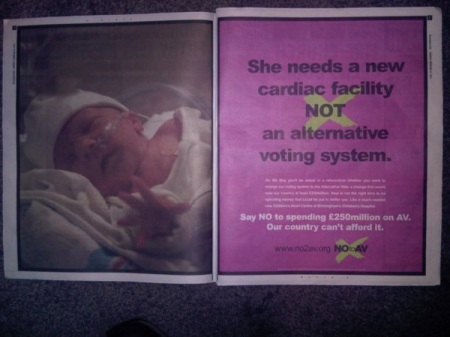
Brazen lies and sick campaigning from No to AV.

I'm getting sick to the back teeth of brazen lies that are perpetually coming from the No to AV campaign, and so thought I'd write this to show exactly why they are completely wrong in their claims,.


They claim that a switch to AV would cost £250m, and then proceed to ask people what better uses that could be put to. First off, I don't think money should be an issue, a dictatorship would be much cheaper than a parliamentary set-up, but somehow that's never wheeled out as an argument for change to having a dictator. Second, the idea that it will cost £250m is a lie, not a misconception but a lie, and a lie upon which No2AV seem to be basing their entire campaign.

To make the massively inflated figure the No2AV campaign had to include the cost of two things, the cost of the referendum itself, and the cost of supposed 'necessary' voting machines.  Point one. How can you claim the cost of AV will include the referendum? The referendum will cost money regardless of whether you vote Yes or No. Are they now campaigning against the referendum itself? Because if so, they could forfeit and save the country a whole lot of money it might otherwise have wasted.

Point two. They claim we will have to spend vast amounts of money on counting machines. The only problem with this claim? An expert from Australia, where AV has been used for a considerable time, has stated that there is absolutely no need for counting machines under AV. And even if we did switch to machines, it was a switch we were looking at making under FPTP anyway! It is not an AV cost, it is a cost of any election.

That leaves a grand total of £26m for the switch to AV on voter education, and even that is a wild exaggeration based on the cost of educating Scottish voters about the STV, an entirely more complex form of voting that required far more information than simply putting numbers from 1 to 5 in order, I imagine the cost of that is covered almost entirely by the teaching given in Reception of Primary School.

If we're going to have a serious debate leading up to this referendum, and there is a debate to be had, then the No campaign needs to stop playing dirty and stop taking voters for mugs. Tell the truth, make your argument, and hope that people side with you. That's how this should be conducted. Or perhaps they're running scared?

Edit: I was linked to this yesterday, turns out not only are they lying to people, but they're resorting to the most sickening campaigning tactics.

NOT how a debate should be held.

Tuesday, 11 January 2011

Lies, damn lies, and the No2AV campaign.

As I pointed out in my last post on the Alternative Vote referendum, the last bastion of argument for the 'No' camp, namely that it produces strong government, has been quashed by the report from the ippr. But it would seem, this will be no walkover, and still No campaigners are using a mix of spin, half-truths, and outright lies to win over voters. Here's a quick sample.


Let's start with the new No2AV leaflet, which has already been thoroughly rebutted elsewhere, but I'll still have a quick glance over.

We start with something that I think will become a key tactic for the 'No' camp, turn it into a referendum on Nick Clegg. (Because let's face it, no-one likes him right now)

"Nick Clegg and the Liberal Democrats want Britain to change the way we vote to a method of voting called the ‘Alternative Vote’, sometimes called AV for short. A referendum is planned for May, when we all get to vote whether we agree with him or not."

Excellent, so its not whether you agree that our voting system is in need of reform, it's whether you want to support the nasty Lib Dems (Boo, hiss!) or whether you want to support the defenders of our nation. (Yay! Ticker tape all round) This kind of spin assumes voters are stupid, mindless drones, who will do your bidding so long as you give the right buzzwords.

The next big one, that surely has to be quashed sooner or later, is the outright and brazen lie that under AV, supporters of marginal parties get more than one vote. As they like to use in the scare tactic, 'Would you like BNP supporters to have more votes than you?'. It's a lie people.

 Everyone gets one vote in AV just as in FPTP. The difference being is that in AV, if your first preference candidate came last, your first vote is eliminated, then you can use your second preference. That's not two votes. That is one vote, then the first being eliminated before the second is counted. All this nonsense about multiple votes is the most infuriating thing about the whole No campaign.

And to finish this particular post, their old favourite, 'AV is only used in Fiji, Papua New Guinea and Australia'.

Quite how that is an argument for us not changing to AV is beyond me. Yes, many more nations do use FPTP, mainly because there electoral system (like ours) was set up in very different times and they haven't got around to changing it. Indeed, many of the countries that use it do so because of there colonial links with the UK. Not so long ago many countries didn't allow women to vote, does that mean we were wrong to change that too?

What the No camp will not tell you, is that FPTP, our current system, has only been taken up by three democracies since 1945, and all of those subsequently changed to something else. Since 1945, not a single country has decided that FPTP is the right system for them to use.

In addition, all the devolved nations of Scotland, Wales and Northern Ireland have decided that FPTP is not good enough for their elections, and so use different electoral systems. Why is FPTP not good enough for them but it'll do for us?

There is no logical argument for keeping First-Past-The-Post, and the No camp knows this. That is why they will turn to spin, to lies, and to brass attempts to turn this into a personality contest. If people are allowed to look at the facts, about what FPTP involves, and what AV involves, they will see that in one system you waste your vote and elect MPs with no mandate. And in the other, you can vote for your real preference, with no tactical voting, and every MP will enjoy the support of over 50% of their electorate.

Yes to fairer votes. Yes to AV.

Thursday, 6 January 2011

Our voting system is irreparably broken.

Yet more evidence, if ever more were needed, that our current First Past The Post voting system is beyond repair, and that there is no logical reason for us to keep it. It shows why anything but a Yes vote for AV in May would be disastrous for democracy in our country.


The way we vote at the moment, putting a cross in the box of our preferred party, was designed for an age of two-party politics. If you have a choice between two opposing candidates, then the logical way to choose between them is a simple vote for one or the other, no ranking is needed. Whoever gets the most votes wins the seat, the party with the most seats wins the election, fairly straight forward, which is the reason FPTP prospered for so long.

But now, as shown by the ippr, the way we vote has changed, and continues to do so. We are less inclined than ever before to vote for the two main parties, and we are increasingly voting for smaller parties which better reflect our interests. As shown in the report, for those who care to read it, FPTP completely fails in the face of multi-party elections. It fails the test both by being hugely unrepresentative, and by failing to produce stable government.

The only argument that No2AV ever had was that we needed to keep FPTP or else we would end up with a succession of Coalition governments (which have been given rather a bad press, largely thanks to the spineless nature of the Lib Dems). This research however, shows that coalition governments are equally as likely under FPTP, because marginal seats (seats likely to change hands at an election) are decreasing rapidly. To form a majority government one party would need a landslide over its opponent.

Of the entire population of nearing 70 million people, it was the votes of only 460,000 people that decided the outcome. And the majority of votes cast in each seat were wasted. If you voted for a losing candidate, or your vote was excess to what the candidate needed to win, it was wasted. You may as well just stayed at home.

We now have a state of affairs where the majority of our MPs were voted into power without the support of at least 50% of the electorate. That can't be fair, and it isn't democratic.

AV lets people vote the way they really want to. No, it isn't proportional representation, but it does give voters the ability to show how they really feel. Never again will people not be able to vote for the candidate they want to because it would be a 'wasted vote' and for once, all the MPs in the House could legitimately say they had the support of at least 50% of their voters.

Yes to fairer votes. Yes to AV.

Friday, 5 November 2010

Yes to AV, yes to fairer votes.

On 5th May 2011, there will be a referendum on changing the voting system in the UK, from the current First Past the Post, to the Alternative Vote. Here's why I think it's time for a change.

It seems bizarre to me that there is even a serious movement that would be opposed to the change in this referendum, but it seems as though there may be a serious fight on the cards to win a change in the voting system. So here's why I think the 'Yes' vote really has to win.


The first idea to quash is that we shouldn't have this referendum because people don't care, and there are other more important issues to deal with than the way we vote people into parliament. Quite how the No2AV campaign can use this as one of their main objections baffles me, we're having the referendum anyway, why would you vote 'No' just because you don't think it should be held? Surely your vote should reflect what you feel on the subject, the question on the paper won't be 'Do you like that we're having this referendum?' Just because there are other more important issues doesn't mean we shouldn't address it, I'm sure that the world won't implode into anarchy because for one day the people of Britain have to go out and put a cross on a piece of paper.

The system we have right now is broken, unfit for the size of the country and for multi-party politics. Whichever way you look at it First-Past-the-Post (FPTP) is unfair. Millions of people up and down the country didn't get a vote at this last election. They may have dutifully gone down to the polling station and filled in their slip, but it was a wasted effort. FPTP means wasted votes, any vote for a losing candidate counts for nothing.

Too many people couldn't even vote for the party that they wanted, because they knew there was no chance of that candidate winning in their seat, they might have been Labour in a Lib Dem-Tory seat or Tory in a Labour-Lib Dem seat, either way they were effectively kicked out of the whole process. They had to vote 'tactically' to try and block the other major party from winning, meaning their own candidate suffered even more. Never again should someone be told that to vote how they want to would be a wasted vote.

With AV you are guaranteed that the winning candidate has a majority of at least 50% of their constituents, something far too many failed to achieve in 2010. There is no need to break the constituency link and it eliminates tactical voting.

Because in AV you rank your candidates, it will often be second preference votes which allow a person to be elected. This will mean they have to appeal to a broad range of people outside their traditional base and rely on picking up second choice votes from them. We will be rid of some the disgusting negative tactics epitomised by Phil Woolas (though he isn't alone, all parties engage in it) because insulting another party will instantly mean losing all their second choice votes. Finally, votes will be cast for policy, not out of fear of the alternative.

So, what could people possibly object to? These are a few choice ones from the No2AV campaign, and are frankly laughable.
  • It will let extremist party supporters (i.e. BNP) have more than one vote - It will give everyone a choice to vote in ranking, yes, but will actually make it harder for extremist parties to get support because it's unlikely that they'll be many people's second choice. Their appeal is very narrow. Score one for an own goal to the 'No' campaign there then.
  • It will 'muddy the debate' in marginal seats - No, what it will mean is that in marginal seats you won't be able to bash the other candidate in a desperate grab for power, you'll have to set out policies which appeal to a broad spectrum of the constituents. 
  • AV is a compromise no-one wants - I know that there are plenty of people (myself included) who think that AV is not enough, we should reform the voting to be much more proportional. But AV is a step in the right direction, and crucially, whilst its not as far as some want, it's infinitely better than what we have right now. A 'No' vote won't be interpreted as a vote for 'AV doesn't go far enough'. It will be seen as a vote for 'we like things how they are'.
But, for the pièce de résistance, this is by far the most condescending, ridiculous and insulting objection of all:

The AV system (i.e. putting numbers from 1 to 5 in a box rather than a cross) is too confusing for people.

Now I'm not sure who exactly many of my readers are, but I'd like to hedge a bet here. I'm willing to put a significant amount of money on the fact that pretty much everyone reading this is capable of not only counting to 5 (in order as well!), but of writing those numbers down in a box.

Vote 'Yes' for AV, yes for fairer votes.
Maybe I give people too much credit, but it doesn't seem like much of a jump from a cross, to numbers.

The No2AV campaign has nothing positive to say because there is nothing positive about the FPTP system they try to defend. So instead, they resort to this condescending negative attack which doesn't even look at the real issue of which is the better voting system, and they end up suggesting that most people would find counting to 5 far too difficult. Utter buffoons.

There are many more reasons to vote for AV than I could mention in one blog, some of which can be found here and here. And there are many more reasons why FPTP is dead, which you can find here. In six months time everyone gets a vote, and for the sake of a fair democracy I pray to whichever God/s you might or might not believe in that you vote Yes.

Friday, 30 July 2010

AV Referendum

There's been some criticism coming from the coalition over Labour's decision to oppose the bill which would allow the referendum on a change to AV voting to go ahead. I thought I'd clear up how its perfectly legitimate to support voting reform (indeed I'd rather we had more reform than just AV) but still oppose this bill which would allow a referendum.


I'll start with what the actual referendum is about, the Alternative Vote. At the moment we use the First past the post (FPTP) system to decide who should be the MP for a certain constituency and the party with the majority of constituencies becomes the government. (Right now we have 650 MP's so any one party needs 326, or parties can work together like the ConDems have done) As it is, everyone gets one vote and whoever wins the most votes in a constituency becomes MP. However, this can be problematic. If two parties are similar then they can split each others vote and mean a less popular party gets in because it doesn't have its vote split. There are other problems in terms of winning votes but not seats (as explained here by a Tory supporting blogger, just to be partisan).

In AV voting we still keep constituencies but rather than getting one vote you can instead rank the candidates. After all the first choices have been counted if no one has 50% of the vote then the second choices get counted and added to the totals. This goes on until someone has 50% and that person is then the winner. This is just one of several choices for reform, you can find the others here.

So back to the point of this post, why are Labour opposing this bill when they had AV reform in their manifesto, is it opportunism like Cameron claims? Well, no is the simple answer.

The reason being that this bill isn't simply for a referendum on AV, it also includes reform to constituency boundaries, which we can't accept. If Cameron did the decent thing and put two separate bills through then we could wholeheartedly support the AV referendum.

The boundary changes are an attempt to equalise the number of voters voting for each MP, which by itself is no bad thing as some constituencies are considerably bigger than others at the moment effectively meaning some people's votes are worth more than others.

What I and others have more of an issue with is the way they propose going about changing the sizes. It is still  very easy to gerrymander (draw the boundaries in such a way that the opposition vote is split and so can't win a seat despite having the same votes) seats that have equal numbers, and that is what these proposals amount to. There are a few reasons why I think the way they plan to do this is deeply unfair and solely aimed at keeping Labour out of power.

Firstly, the speed that they hope to push through the changes means that they will have no chance to tackle the problem of people who aren't registered on the electoral register. If they aren't on the register they are effectively frozen out of the whole process. This problem of under-registration is most severe in dense urban areas, the very seats which Labour typically win. By going ahead with the reform before making sure people are registered they will ensure that urban areas, and by proxy Labour, are under-represented.

That's also the case with the arbitrary reduction of the number of seats from 650 to 600. Why, when they want to give more power to people, are they reducing the influence that the public has. This cut will mean each member of the public has proportionally less representation than before. And more than that, the devious choice of 50 seats to be rid of is designed purely for political gain. The cuts of 50 seats will mainly hurt Labour as we lose a quarter of Welsh seats and historically Labour held seats are merged.


Then there's the much more obvious deception of the Lib Dem's who have put in special exemptions for a small number of seats, which coincidentally happen to be held by themselves and will provide them with safe seats that they might otherwise have lost. It's the most blatant gerrymandering element of the whole bill.

My final reason for opposing it is that far from their idea of 'big society' this is hurting the local community's power to have a say. Traditionally, local communities have had the chance to appeal against certain boundary changes that would cut across tight knit areas. This bill removes the public right to challenge, and gives all that power to central government. Hardly in keeping with the Cameron rhetoric of less centralisation is it?


In short, neither partner in the coalition wants one half of this bill, the Tory's don't want AV and the Libs don't want this change in boundaries. That's the only reason I could think that these two distinctly separate issues are being packaged together as one. If we want to oppose blatant gerrymandering we have to oppose the part of it we actually want as well, AV reform. Its a stunt from Cameron so that he can paint Labour as going back on their word when in fact we've done nothing of the sort. In case you're still not convinced, here's what the Labour ammendment actually said:

“That this House, whilst affirming its belief that there should be a referendum on moving to the Alternative Vote system for elections to the House of Commons, declines to give a Second Reading to the Parliamentary Voting System and Constituencies Bill because it combines that objective with entirely unrelated provisions designed to gerrymander constituencies by imposing a top-down, hasty and undemocratic review of boundaries...”

The solution is simple, split the bill in two, let us vote for the referendum and oppose this blatant political cheating that they are trying to push through.